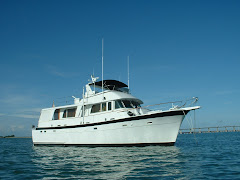
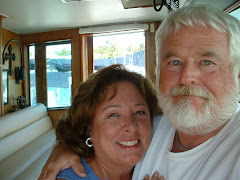
We have had a good time getting to know some of the local folks. Last weekend, there was a sort of End-of-Hurricane-Season party at the pool and gazebo here at Coral Cove Marina. Our Columbian friends Suje and Liliana provided an excellent evening meal, and another cruiser brought a music setup for dancing. Cold beer and fine Guyanese rum rounded out the refreshments, and a good time was had by all.
Our recent blog entries probably give the impression that life here is one big party. Actually, we've been working our buns off on the boat. We only seem to take pictures when we're among other people, and generally those are social occasions. Cruisers do know how to party, though.
For example, yesterday, we changed the oil and oil filters in both main engines and the big generator. This has to be done every 150 to 200 hours of running time. We also topped up the 24-volt battery bank with distilled water, a quarterly task. And late yesterday evening, we cleaned out the thru-hull and raw-water strainer for the air-conditioning system to improve its cooling performance.
We're trying to top up our fuel tanks with diesel at a reasonable cost. Looks like we may have a line on it for $1.50 per gallon. We need about 1800 gallons before we take off. We would like to be able to leave here late next week.
Once our tanks are full again, we plan to move up the islands to Puerto Rico rather quickly, then take six or seven months to come back down again for the next hurricane season. Depending on weather, we will probably be in PR or the Virgin Islands for Christmas. When we came down-island in June/July, we were in a hurry to get south of the hurricane belt, and so we bypassed a lot of places we really want to visit; St. Bart's, Martinique, Antigua, etc.
One of the things most people probably don't know is that most full-time, long-range cruisers are grey-haired folks like us, some much older. We know two couples here that are in their mid-80's. The yachting and boating magazines are full of pictures of young people in bikinis and speedos running around in megayachts and fast boats. Truth is, for every one of those, there are a hundred retired or semi-retired couples, typically running a 40-foot sailboat. We are a bit of a rarity, in that we are running a comparatively big motor yacht. In any harbour, we are likely to be the largest boat around. The sailboaters are generally friendly, but envious, since we have amenities their boats cannot support. Two ice-makers, huge refrigerator, extra freezer, washer/dryer, full-size bathtub, air conditioning, etc. Susan sometimes invites other cruising wives to come aboard to do their laundry, though so far they have been too proud to accept. When there are get-togethers, they always ask us to bring ice.
If all goes well, we may be cruising northward to Grenada on Thanksgiving Day, so we will be out of touch for a bit. That is a 90-mile, 12-hour crossing against the prevailing easterly current. We will enjoy imagining everyone sitting down to Turkey and all the trimmings, while we munch on peanut butter sandwiches and power bars - our typical underway snacks.
Tuesday, November 18, 2008


Friday, November 14, 2008
Divali in Trinidad
Divali (pronounced "deewallee") is a national holiday in Trinidad. Traditionally it is a Hindu celebration surrounding the return of Lord Krishna from exile. That it has become a national holiday here speaks to the influence and significance of the East Indian population of the country.
Divali itself is preceded by a week of prayer, fasting and feasting. Also known as "The Festival of Lights", for the symbolism of the return of the light of God into the world. Celebrants light hundreds of votive candles in their homes, along outside walls, courtyards and driveways. It looks a bit like Christmas in the US, except with candles instead of strings of colored lights. Devout households hold open house, offering sweets and other tasty treats to their friends and neighbors. On the day of Divali, non-Hindu Trinidadians prepare a wonderful family dinner, which reminds us a bit of Thanksgiving.
Sam Haynes invited Susan and me to attend the celebration at his sister's home in San Fernando. Sam and his girlfriend Wendy picked us up at Coral Cove at 11:00am, and we drove South for a couple of hours. Sam's sister Thelma greeted us as honored guests, and we enjoyed a sumptuous meal at her table. Thelma cooked traditional Trinidadian foods: Roti, roasted chicken, stewed goat, potatoes, mashed pumpkin, mango chutney, curried rice, and and ice cream for dessert. Ice cold Carib beer was plentiful.
After this feast, we enjoyed conversation with the family regarding the upcoming US Presidential election, only days away. Our hosts were really excited that Barak Obama appeared likely to win. They expressed great hope for his presidency and for the world.
In the afternoon, Sam invited Susan and me to go with him on a tour of the area. We stopped and picked up Sam's old boyhood friend Michael. Michael is a long-time employee at the huge oil refinery at San Fernando. His security pass enabled us to tour the grounds of the facility, which is truly impressive. On the grounds, in addition to the refining equipment, there is a health and safety clinic, lovely housing for senior staff, a golf course and pool, and a sports complex set up for cricket and soccer.
We then drove up to the top of a large hill overlooking the bay and the city. I fail to recall the name of this mount, but it was a lovely park, with lots of picnic tables open to the magnificent view.
On the way back to Thelma's home, we stopped for a beer in town, at what Sam calls a "typical Trini Sports Bar". In fact, it was named "Sports Bar". We "limed" for a bit with a retired tugboat captain until it was time to head for home and a bit of music.
Back at Thelma's, the courtyard was now set up with an enormous wall of speakers, playing some of the best Caribbean music we had heard so far in our travels; mostly Calypso and old-school Reggae. The extended family had arrived, and were served their evening meal. Everyone was stuffed, and were mostly "chair dancing", except for me. I could not sit still, and so I be-bopped and shuffled around the courtyard like a slightly crazed muppet, moving to the beat that was now imbedded in my entire body, along with the food, rum and beer.
Night fell, and we gazed at the array of lights, and fireworks began to loft into the sky. We walked some of the neighborhood chatting with residents and enjoying the cool of the evening.
The boys "liming" at the Sport's Bar in San Fernando
from left - Walt, Sam, Tugboat Captain (retired), and Michael


Susan and Sam's Niece - liming at Thelma's
Sam and Wendy at Thelma's
Susan and our host - Sam's sister Thelma
Thelma and Sam's nieces - and their little green friend
That reminds me... a large flock of these beautiful green parrots fly over our boat every morning at daybreak, and back again just before sunset. While it is technically a flock of birds, they fly as pairs, male and female, side by side. It's like they're going off to work each morning, and returning home in the evening. We've noticed that as each pair goes over, one of them is quite verbal, and the other is quiet. Not sure, but we speculate that the verbal one must be the female! Susan has named each pair Lucy and Ricky!
Divali itself is preceded by a week of prayer, fasting and feasting. Also known as "The Festival of Lights", for the symbolism of the return of the light of God into the world. Celebrants light hundreds of votive candles in their homes, along outside walls, courtyards and driveways. It looks a bit like Christmas in the US, except with candles instead of strings of colored lights. Devout households hold open house, offering sweets and other tasty treats to their friends and neighbors. On the day of Divali, non-Hindu Trinidadians prepare a wonderful family dinner, which reminds us a bit of Thanksgiving.
Sam Haynes invited Susan and me to attend the celebration at his sister's home in San Fernando. Sam and his girlfriend Wendy picked us up at Coral Cove at 11:00am, and we drove South for a couple of hours. Sam's sister Thelma greeted us as honored guests, and we enjoyed a sumptuous meal at her table. Thelma cooked traditional Trinidadian foods: Roti, roasted chicken, stewed goat, potatoes, mashed pumpkin, mango chutney, curried rice, and and ice cream for dessert. Ice cold Carib beer was plentiful.
After this feast, we enjoyed conversation with the family regarding the upcoming US Presidential election, only days away. Our hosts were really excited that Barak Obama appeared likely to win. They expressed great hope for his presidency and for the world.
In the afternoon, Sam invited Susan and me to go with him on a tour of the area. We stopped and picked up Sam's old boyhood friend Michael. Michael is a long-time employee at the huge oil refinery at San Fernando. His security pass enabled us to tour the grounds of the facility, which is truly impressive. On the grounds, in addition to the refining equipment, there is a health and safety clinic, lovely housing for senior staff, a golf course and pool, and a sports complex set up for cricket and soccer.
We then drove up to the top of a large hill overlooking the bay and the city. I fail to recall the name of this mount, but it was a lovely park, with lots of picnic tables open to the magnificent view.
On the way back to Thelma's home, we stopped for a beer in town, at what Sam calls a "typical Trini Sports Bar". In fact, it was named "Sports Bar". We "limed" for a bit with a retired tugboat captain until it was time to head for home and a bit of music.
Back at Thelma's, the courtyard was now set up with an enormous wall of speakers, playing some of the best Caribbean music we had heard so far in our travels; mostly Calypso and old-school Reggae. The extended family had arrived, and were served their evening meal. Everyone was stuffed, and were mostly "chair dancing", except for me. I could not sit still, and so I be-bopped and shuffled around the courtyard like a slightly crazed muppet, moving to the beat that was now imbedded in my entire body, along with the food, rum and beer.
Night fell, and we gazed at the array of lights, and fireworks began to loft into the sky. We walked some of the neighborhood chatting with residents and enjoying the cool of the evening.
Thelma's Divali Feast - Thelma (our host) at right, Sam, Susan, and Wendy


The boys "liming" at the Sport's Bar in San Fernando
from left - Walt, Sam, Tugboat Captain (retired), and Michael

Sam, Susan, and Michael in the overlook park

View of San Fernando bay and city

Susan and Sam's Niece - liming at Thelma's

Sam and Wendy at Thelma's

Susan and our host - Sam's sister Thelma

Thelma and Sam's nieces - and their little green friend

That reminds me... a large flock of these beautiful green parrots fly over our boat every morning at daybreak, and back again just before sunset. While it is technically a flock of birds, they fly as pairs, male and female, side by side. It's like they're going off to work each morning, and returning home in the evening. We've noticed that as each pair goes over, one of them is quite verbal, and the other is quiet. Not sure, but we speculate that the verbal one must be the female! Susan has named each pair Lucy and Ricky!
All work and no play...
makes Walt a dull boy!
After weeks of work on the boat, both ashore at Peake's Boatyard and in the water at Coral Cove Marina, we took off on a Saturday for a picnic at Scottsman's Bay.
Teffany and her friend Paul wanted to do a Guyanese "cookup" for us. They are both excellent chefs. Paul started out by grating the meat of two fresh coconuts and creating the coconut milk broth that is essential in Guyanese cuisine. He then chopped and prepped vegetables for the salad, while Teff steamed brown rice and added chicken and beef. By noon, all was prepared, and we took the boat on a short cruise to Scottsman's Bay. Dropping the hook, we relaxed, ate this scrumptious meal, and generally "limed" until time to head back to Coral Cove.
By the way, in Trinidad, as well as much of the Caribbean, "liming" is a common reference to "hanging out with one's friends", and dates back to the British occupation. It seems that the "limeys" were known for their extended after-work cocktail hour. British seamen and soldiers were issued limes to fight scurvey on their long passages, and made all sorts of beverages using limes. Rum and lime, gin and lime, vodka and lime, etc. You get the picture. So the natives began to "lime" as well.
Dusk, looking west from our foredeck at Coral Cove
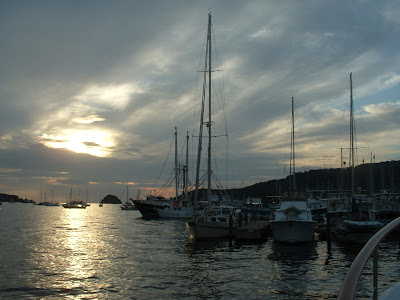
Nikki, Paul, Teffany, and Brian in full "lime" mode

Carol at the helm of KINGDOM

Typical sunset in Trinidad

View of Crews' Inn Marina and restaurant - directly across from our berth at Coral Cove

A typical Trinidadian pirogue - widely used as fishing and utility boats. They are fast, maneuverable, and apparently economical to run. We've noticed that their designs are different in each island group, though similar in size and function.

After weeks of work on the boat, both ashore at Peake's Boatyard and in the water at Coral Cove Marina, we took off on a Saturday for a picnic at Scottsman's Bay.
Teffany and her friend Paul wanted to do a Guyanese "cookup" for us. They are both excellent chefs. Paul started out by grating the meat of two fresh coconuts and creating the coconut milk broth that is essential in Guyanese cuisine. He then chopped and prepped vegetables for the salad, while Teff steamed brown rice and added chicken and beef. By noon, all was prepared, and we took the boat on a short cruise to Scottsman's Bay. Dropping the hook, we relaxed, ate this scrumptious meal, and generally "limed" until time to head back to Coral Cove.
By the way, in Trinidad, as well as much of the Caribbean, "liming" is a common reference to "hanging out with one's friends", and dates back to the British occupation. It seems that the "limeys" were known for their extended after-work cocktail hour. British seamen and soldiers were issued limes to fight scurvey on their long passages, and made all sorts of beverages using limes. Rum and lime, gin and lime, vodka and lime, etc. You get the picture. So the natives began to "lime" as well.
Dusk, looking west from our foredeck at Coral Cove

Nikki, Paul, Teffany, and Brian in full "lime" mode

Carol at the helm of KINGDOM

Typical sunset in Trinidad

View of Crews' Inn Marina and restaurant - directly across from our berth at Coral Cove

A typical Trinidadian pirogue - widely used as fishing and utility boats. They are fast, maneuverable, and apparently economical to run. We've noticed that their designs are different in each island group, though similar in size and function.

Teffany, Carol, Brian, and Sam
Sam Haynes, known as "Uncle Sam" to his friends, is the acknowledged master of varnish in the Chaguaramas boatyards. He greeted us on the first day we hauled our boat out of the water at Peake's Boatyard. The first thing he said was "Your bow rails look terrible! Let me varnish them for you." Over the last month, he has transformed the varnish on KINGDOM so that it looks like a new boat. He has refinished our pilothouse walls and flooring, rails, stairwells, aft deck doors, salon doors, everything looks grand! He also attacked and eliminated rust in our engine room, removing it and repainting where necessary. He has provided us a wealth of information on specialized products to use to maintain marine finishes, and taught us how to use them.
Sam also found us high-quality workmen and craftsmen of all kinds. All we had to do was mention a project we had in mind, and the next day, someone would appear to handle it for us. He found a guy to clean the bilges, a refrigeration expert to repair our flybridge icemaker and faulty air conditioners, and a painter to repair stress cracks in fiberglass.
Most important, when we talked of going to Venezuela for fuel, he recommended Carol Lall to us as an experienced crew member. Carol, a Guyanese national, has 18 years of crewing experience aboard all kinds of vessels, and is a licensed seaman. She speaks several languages, is fluent in Spanish, and has visited nearly every port on our itinerary. Carol introduced us to her daughter Teffany Padmore, also Guyanese, also licensed, and who is most interested in marine engineering.
Sam is originally from St. Vincent, and was reared in San Fernando, in the southern part of Trinidad. He has spent much of his life aboard boats or working in boatyards. He is a tall, dignified man, very well spoken, and takes fierce pride in the quality of his work. We have become good friends over the last six weeks.
Sam and Walt in the pilothouse

Carol Lall (foreground)

Brian, a family friend from Guyana, came to visit Carol and Teffany. He is a Cuban-trained physician in Guyana. His specialty is Intensive Care Medicine (an internist who works primarily with ICU patients). He has taken a 90-day leave of absence to decompress from the stress of his job. As a change of pace, he is delighted to help perform the simpler tasks of maintenance (shown here repainting a fan from our salon).

Teffany loves solving mechanical problems. Nothing intimidates her! She is shown here squeezed into a small space in our engine room, while replacing a macerator pump that she just rebuilt.

Columbian Fiesta on KINGDOM
One evening, we had an impromptu party with friends from another boat, NAXOS. Peter is British, and is married to Suje (yellow dress) who is Columbian. Rounding out our small group were Jerry (the big guy), who is Trinidadian, and his girlfriend Iliana, also from Columbia. Suje and Iliana speak mostly Spanish, but understand some English. Peter and Jerry both speak fluent Spanish, and interpreted as necessary.
They brought CD's of a variety of Caribbean music - Soca, Calypso, Samba, Reggae, and more. Dancing soon broke out in our little salon, and we had a wonderful time!
Susan and me doing our thing...

The "three amigas" doing the KINGDOM version of pole dancing

Iliana, Suje, and Susan

Walt, Peter, and Jerry study the globe

Impressions of Trinidad
It is really impossible for us to claim any sort of intimate knowledge of this country, since most of our time has been spent in boatyards and marinas. A few months are really too short a time to learn very much about anyplace you go.
However, we have formed our initial impressions, and will share them with you here.
The Economy
Chaguaramas is somewhat isolated from the rest of the country, an enclave devoted to the yacht service industry, as well as repair facilities for the local fishing fleet. The Trinidadian Coast Guard also has a base here. The commercial port is in Port of Spain.
The larger economy of Trinidad is driven by the exploitation of oil and gas reserves. Revenue from the export of these two natural resources is the basis of most of the government’s revenue, and thus the companies involved in the oil business are catered to by the various government agencies and departments. It is unclear how this segment of the economy directly benefits ordinary people, since the number of Trinidadians actually employed in the oil industry is rather small.
The second largest segment of the economy is the marine service industry, comprised of the businesses serving both private yachts and commercial fishermen. Private yacht owners spend an average of $20,000 during a three or four month stay in Trinidad. Many owners store their boats here for extended periods while they travel to their home ports to attend to their families, business interests, or homes ashore. There are approximately 1,000 yachts here at any given time, the bulk of them “on the hard” for hurricane season. Owners are from all over the world. We have met lots of Europeans, including British, French, Swiss, and Spanish nationals. There are a fair number of Australians and New Zealanders, and of course a ton of Americans.
With the exception of Tobago, there is no discernible Tourism industry. On the island of Trinidad, as far as we can see, there is not much official interest or government focus on developing one. The countryside is beautiful, much of it mountainous, with several distinct eco-systems. Beaches abound on the north side of the island.
There is no personal income tax. However, they levy something called the “Value Added Tax”, on a wide variety of selected goods and services, which appears to be something like a sales tax. The Trinidadian Customs Service levies fairly steep duty charges on most imports.
Social Structure
The local population appears to be primarily composed of people descended from of Africans and East Indians, mixed with Latin Americans, a few Europeans (primarily Dutch) and a very small remnant of the indigenous Carib Indian tribes. Over time, there has been a good bit of intermarriage, so racial and ethnic lines are somewhat blurred. There is an undercurrent of racial consciousness in some areas. We are told that there are enclaves (small towns or villages) where people of a particular ethnic extraction appear to have concentrated to the virtual exclusion of others. But we have not personally seen this. We have not directly seen or experienced much in the way of overt racial tension between the various ethnic groups, but we know from reading the local newspapers that it does exist.
We have personally enjoyed meeting Hindus, Muslims, Christians, and Rastafarians, all of whom have been well represented among the business owners, craftsmen, and workers that we have engaged during our stay. Our observation has been that business owners, managers, and professionals tend to be mostly of East Indian extraction, whereas clerks, craftsmen, and laborers tend to be Africans. This has been remarked upon by many of the other cruisers we’ve met, and confirmed by Trini’s we have befriended.
What follows are two generalizations we have come to feel are somewhat valid, but we want to acknowledge that we have seen and experienced remarkable exceptions.
People of East Indian and Asian extraction seem to bring with them a particularly keen cultural desire, or drive, to start family businesses. Working together, and by pooling their resources, they are able to raise the capital to start or buy businesses of all kinds, both large and small. They tend to see to it that their young people get the best education available to them, and expand their influence in the marketplace.
We don’t entirely understand why, but in this culture, people of African extraction appear to be less driven to educational, commercial or professional achievement. It isn’t that they are unwilling to work hard. Overall, our experience with local craftsmen and contract labor has been good. As a rule, the quality of their work has been more than satisfactory, and in some cases, exceptionally good. Admittedly, we have only engaged workers that have been recommended to us by others. On only one occasion, a contract worker started a job, and then abandoned it with no notice of his intentions for more than a week. We hired another fellow to complete that job during his absence.
Why Trinidad?
Why Trinidad ??
There are three major reasons why yachts to come to Trinidad.
The first is that Trinidad is south of the hurricane belt. Chaguaramas is below 10.41 degrees latitude, so it qualifies as a legitimate hurricane-free zone. Yacht insurance companies will not honor storm damage claims to boats lying north of this latitude. Most yacht insurance policies specifically exclude the zone running from this latitude, all the way north to Georgia.
Second, Chaguaramas is widely known for its well-developed yacht service industry. Local craftsmen, chandleries (marine hardware vendors), several boatyards, marinas, restaurants, and other suppliers are all available and at reasonable prices (compared to other islands and especially the U.S.). Downside is that if one must order specialty items from offshore, the customs fees are high. Grocery and restaurant prices are similar to those in the U.S.
Third, (and very important to us) Trinidad has historically offered fuel to visiting yachts at extremely low prices. While that is no longer the case, it is still a somewhat better value than up-island. While diesel is now $4.25 per gallon in Trinidad, the islands north of Trinidad typically charge $5.50 or more per gallon. Now we have to go to Venezuela for really cheap fuel. Diesel is available there for as low as $.50 per gallon in some ports.
There are also a number of intangible attractions offered by Trinidad.
For example, English is the official language. While many Trini’s speak a rapid “patois” when talking among their countrymen, they are generally happy to slow down and speak perfectly good English when conversing with non-Trini’s like us.
Health services are readily available, reasonably priced, and of good quality. Pharmacists and physicians are usually highly trained, mostly in the U.S. and Europe.
There are all sorts of sightseeing excursions and cultural events available to visitors. Everything from concerts to national parks is on offer.
We have been especially impressed by the wide variety of services offered by Jesse James, owner of “Members Only Maxi-Taxi Service”. He has dedicated himself to providing every sort of transportation service to visiting yacht owners and crews. He arranges to get people to and from the airport and the various marinas (day or night); he offers weekly shopping trips to major food stores, fresh markets and malls; weekly tours of national parks, including hiking and lectures; bi-weekly movie matinees; etc. etc. He is the guy you call to help you find a doctor or dentist, or for any kind of emergency, even locating hard-to-find boat parts. Beyond all that, he is a wonderful person, a family man who truly cares about others. His employees all love him, and praise him to their customers as an example of the “ideal boss”, who inspires loyalty and a service mentality in his own employees. A group of us yacht folk hired Jesse to transport 14 of us to a wonderful Indian restaurant in Port of Spain. In appreciation for all he does for us, we invited him to bring along his wife and daughter to dine with us at our expense. He graciously accepted, and in return, he refused payment for the transport!
Subscribe to:
Posts (Atom)